|
|
Lexington

|
|
 |
|
|
Lexington was the greatest of the great American four-mile runners and the greatest of the great Nineteenth Century American stallions. Modern visitors to the city of Lexington in the heart of Kentucky's horse country are reminded of this remarkable horse every day since his image in blue can be seen everywhere guiding tourists to the beauty and history of the region. Lexington clearly hasn't forgotten Lexington, or what he did for Kentucky or what he did for the Thoroughbred.
The birthplace of the horse known as Lexington lies within the current city limits of his namesake town. He was bred by Dr. Elisha Warfield (1781-1859), one of the most important early figures in Kentucky racing and breeding. Originally from Maryland, Warfield was a prominent physician and professor of surgery and obstetrics at his alma mater Transylvania University. He retired from medical practice to engage in other pursuits including his family's local mercantile and ownership in the Lexington and Ohio Railroad, besides breeding racehorses. In 1826 he became one of the founders of the Kentucky Association Race Track, which was built on land adjacent to his farm.
The Association track is long gone, although its historic gate post with the famous "KA" now graces the entrance to Keeneland Racecourse on the other side of town. Vestiges of The Meadows still remain just a few blocks north and east of modern downtown Lexington. Once sitting just outside the city, stone pillars mark the western border on Bryan Avenue at the corner of Emerson Drive and on Warfield Place, which used to be the drive to Warfield's mansion. Castlewood Park was once a part of The Meadow. Warfield's farm extended west all the way to Winchester Road and north to about where New Circle Road now crosses. After Warfield's death, the farm was sold out of the family and through a series of owners. Subdivision plans began in the early 1900s and the mansion was torn down in 1960. |
His dam, Alice Carneal | |
Lexington was foaled at The Meadow on March 17, 1850, a bay colt by Boston out of Warfield's mare Alice Carneal. An old photo exists of a building said to be where Lexington was foaled. It strongly resembles the big stable that used to sit behind the Warfield mansion. |
His sire was Boston, the great champion of the 1830s and 1840s, winner of 40 of his 45 races over eight seasons of racing. After standing six years in the Virginia area, Boston was brought to Kentucky to stand at Col. Ned Blackburn's Equiria Stud in Woodford County in early 1847. He made just three seasons there before his death on January 31, 1850. Although a good sire in Virginia, his best runners were out of mares he covered in Kentucky, particularly those from that last Kentucky-sired crop, which included Dr. Warfield's bay colt and Gen. J. D. Well's chestnut colt LeComte. Boston was sired by Timoleon, a son of the previous epoch-making American stallion, Sir Archy.
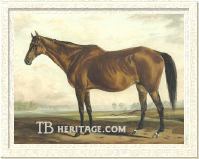
Lexington's dam was Dr. Warfield's homebred mare Alice Carneal, named for one of his daughters-in-law, the wife of his son Thomas. The mare was sired by the imported horse Sarpedon, a good runner in England including a win in the Stockbridge Gold Cup and second in the 2,000 Gineas. He was brought to stand initially in Virginia in 1834, then sent to William G. Skillman's farm near Lexington for the 1835 season, the year Alice Carneal was conceived. Her dam was Rowena by the good runner and sire Sumpter, a son of Sir Archy. There were some questions marks over Alice Carneal's female line starting at her granddam Maria, a very good race mare by Melzar, but her female line of mares by imported Highflyer, imported Fearnought, Jack of Diamonds, then the mare Spotswood's Old Diamond came into question, even by Dr. Warfield, who took the pedigree certificate when he bought Rowena from Robert Sanders in about 1828. The consensus at the time was that Lexington's performance superceded any question about the purity of his pedigree, since only a true thoroughbred could run that way.
Alice Carneal was an extremely high strung filly and hard to train as a result. She made her first start at five, in 1841 at Crab Orchard, Kentucky, placing second to John Young in a $100 race at mile heats in deep mud. She didn't run again until the next year's Spring Meet at her home track in Lexington, where she ran third to Leda and Jenny Richmond in another $100 purse over mile heats. At the Lexington Fall Meeting, she was again third in a $400 race stretching to three mile heats, losing to the good horses Creath and Dick Menifee. The same year in September at Georgetown, Kentucky, she was finally a winner, taking a $200 purse by winning the third and fourth two mile heats getting revenge on Dick Menifee and Creath. Warfield also claimed that she won a race of two mile heats at Forks of Elkhorn near Frankfort, Kentucky that fall, but no record of this race can confirm the win. At six, Alice Carneal made two starts without another win. She was third at Lexington over four mile heats to Miss Foote and Argentile. Alice won the first heat leading all the way and tried the same tactic in the second heat but only lasted three miles before being distanced. The heats, run in 7:42 and 7:40 were very fast and the final time credited to Miss Foote was the fastest on record in Kentucky to that time, thanks to Alice Carneal's self-defeating effort. In her next start at Louisville over two mile heats, Alice Carneal was third behind Sally Shannon and Camilla. As a seven-year-old, she ran poorly in a $200 race at Louisville over two mile heats and was retired.
Warfield knew he had a filly of great ability but her temperament worked against Alice Carneal proving how good she was. Lexington was her fifth foal. Her fourth, the filly Maid of Orleans (1849 by Berthune) would win 20 races. After Lexington, Alice Carneal foaled the high class runners Waxy (1851 c. by Buford), Release (1852 f. by Berthune), Rescue (1854 c. by Berthune), Lavender (1855 f. by Wagner), Umpire (1857 c. by LeComte) and Annette (1859 f. by Scythian). The latter two were stakes winners in England, Umpire being particularly good and was favorite for his year's Derby Stakes. A couple of Alice Carneal's daughters became excellent producers. Lavender produced champion Baden-Baden and Saratoga Cup winner Helmbold, both by Australian. Rescue was the dam of Abd-El-Kader and Abd-El-Koree, both also by Australian.
Alice Carneal's 1850 colt by Boston was originally named Darley, because he reminded Dr. Warfield of portraits of the Darley Arabian, a bright bay with white on his face and four white feet. Darley would have undoubtedly got his early training at the nearby Kentucky Association track in Lexington. Warfield, who was now in his early 70s, was starting to scale back his racing operation and leased the colt to Harry Lewis, a freed black man who had served as trainer for such distinguished Kentucky horsemen as Sidney Burbridge and Capt. Willa Viley. Racing in the name of Dr. Warfield and in his blue and white colors, Darley made his first start on May 23, 1853 as a three-year-old in the Association Stakes contested over mile heats at the Lexington track. The contestants were overly excited, possibly due to the driving rain and horribly muddy conditions. The Boston colt found himself part of the group of four that bolted before the start was called. Despite having run over two miles before being brought back for the official break, in the race itself Darley led from flagfall to finish as he did in the second heat, leaving a remarkable first impression.
This performance did not go unnoticed by the famous racing personality Richard Ten Broeck (1811 - 1892). Ten Broeck was born in Albany, New York. His father was from an old Knickerbocker family, and his mother was from the Bicker family of Philadelphia. In 1823, when a boy of 11 years, his father took him to see the famed North/South contest at the Union Course on Long Island. He would have cheered to watch the New York horse American Eclipse defeat the Virginia horse Henry. It was here young Richard may have first seen or even met the legendary William R. Johnson, known as "the Napoleon of the Turf," and the manager of Henry. A few years later, Richard was serving as a messenger at the New York Assembly. In 1829 he was accepted as a cadet at West Point, but left in early 1831 under clouded circumstances. He apparently found himself in a dispute with an instructor over an insult, possibly challenged the instructor to a duel, and was either expelled or, as Ten Broeck wrote later, he resigned. His next few years after that remain a mystery but somewhere along the line, he seems to have learned the fine art of gambling both with cards and at the races.
In the 1840s Richard Ten Broeck became a partner with William R. Johnson who was still going strong with his stable based at Oaklands in Virginia. Ten Broeck would have been an involved party during the years Boston raced for Johnson, including his 1842 defeat by Fashion in their famous match race, which cost the partnership thousands in purse money and gambling losses. Ten Broeck made New Orleans his base and from there launched a brief foray with some horses to Havana, Cuba with mixed results. In 1844, he leased the great filly Peytona and for him she avenged Boston by beating Fashion in their North/South race in 1845. Ten Broeck made a successful expedition with several horses, including the good Sallie Ward, into Canada. In 1847 he became manager of the Bingaman Course in New Orleans, the Bascombe Course in Moblie and bought into the Metairie Course, the belle of race courses in New Orleans. In 1849, William R. Johnson died and Ten Broeck was on his own, continuing his racetrack entrepreneurship with great success. He was still buying horses to race and also breeding his own, including the high class runners Archer and Pryor.
The Spring of 1853 found Richard Ten Broeck at the Kentucky Association track. Always the promoter, Ten Broeck was looking for owners with horses to run for the Great State Post Stakes, scheduled for April of the next year at his Metairie Race Track. The idea was for owners to send horses to represent their state in the big event in the spirit of friendly regional rivalry. Watching the first-time starter Darley romp home in the mud, Ten Broeck came up with a plan with some of the leading local horsemen gathered around him including Capt. Willa Viley, Viley's brother-in-law and racing partner Junius R. Ward, and Col. Abe Buford. The four of them pooled their money and Ten Broeck made an agreement with Dr. Warfield on behalf of the syndicate to purchase the Darley for $2,500 prior to the Citizens' Stakes to be run just a few days later. Warfield would receive a further $2,500 if Darley won the Great Post Stakes. In the Citizens' Stakes over two mile heats, the Warfield colt lost the first heat to another Boston offspring, John Harper's filly Midway, then won the next two for the victory. Harry Lewis had apparently not been privy to the deal and learned of the sale of what he thought was his prize colt only after the race. To add insult to injury, Ten Broeck attempted to pocket the purse but Warfield and Lewis disputed his claim with the stewards, as the parties who put up the entry fee and Lewis was granted the purse.
Capt. Viley took over the position of managing the Boston colt, who was sent to Ten Broeck's trainer, John B. Pryor. Pryor had stables at the Fatherland Plantation of his father-in-law Col Adam Bingaman at Natchez, Mississippi. Besides being a great trainer, Pryor was unusual for his times, being a white man who married a mulatto woman. Bingaman himself had a family with a free black woman and Pryor's wife, Frances Ann was one of at least six children the couple raised. John and Frances Ann had a large family and several of their sons, listed in various census records in America and England as mulatto or black, went on to become successful trainers.
Ten Broeck announced his purchase of Warfield's colt Darley in The Spirit of the Times, and explained that he was renaming him "Lexington," to honor the home city of his partners and to generate regional interest in his planned event the next April. The colt's schedule was interrupted by an incident in October that was initially kept secret by Pryor. According to a letter he wrote to the Kentucky Livestock Record in February of 1881, he describes the events.
"The late Capt. Wm. J. Minor [a prominent horseman and neighbor to Bingaman] told me he would like much to see him [Lexington] work, and I invited him to come the next morning. That night Lexington got out of his box stall, and stood the whole night at the feed box. My stable was a large one, with a passage in the middle, and double doors on each end, and the bars must have been left down of his door, so that he could get out in the passage to the feed box, and I not knowing this, when Captain Minor came worked the horse two miles. He moved so slugglsh that I knew there was something wrong, and I did not give him any more work. As soon as Captain Minor went away I went over to the stable to see what was the matter. I found the horse with a high fever, both eyes closed, and I bled him freely. At the same time told Old Henry (my headman) he had to tell me how the horse came in such a fix, and he he frankly acknowledged getting out of the stable to the feed-box, and ever after this his eyes were effected. I have no doubt that working the horse full brought it about. He shrunk to nothing, and it was more than a week after he ate nothing but a few green blades of fodder."
Ten Broeck later said he was never made aware of the stable incident until long after, but surely Pryor had some explaining to do over the colt's physical collapse. It set his training back seriously enough to warrant concern whether he was fit for a match with the filly Sallie Waters (by Glencoe), Alabama's champion, at Metairie over three mile heats on December 2. Trained up to the race, he dashed those worries by taking the first two heats over a heavy course, distancing the filly in the second and leaving no questions about his ability.
Lexington spent the next four months prepping for the Great State Post Stakes to be contested on April 1, 1854 for a $20,000 purse and run over four mile heats at Ten Broeck's home track, Metairie in New Orleans. Representing the State of Kentucky he met his most serious challenger, another colt by Boston named LeComte who represented Mississippi for owner T. J. Wells. The two other starters were the Glencoe colt Highlander running for Alabama, and the Boston gelding Arrow, for Louisiana. Lexington again led from start to finish in the first heat, with LeComte second. Sitting behind the pace in the second heat, Lexington rallied in the final mile and was drawing away from LeComte at the finish. Ten Broeck would have owed Dr. Warfield the $2,500 bonus promised for his colt beating the best in the country.
Then came a disagreement about the colt's racing futures. Capt. Viley is said to have directed that the colt had been training hard and needed some rest. He had Lexington's shoes pulled and sent him to enjoy some turn-out time. Meanwhile, Ten Broeck had arranged for the colt to return just a week later in the Jockey Club Purse at Metairie. Viley protested but money talked. Ten Broeck bought out the interests of the other syndicate members, valuing the colt at $5,000, so Lexington was back in action in the Jockey Club Purse over four mile heats. Viley was vocal about his unhappiness with Lexington's appearance at the race. In fact, LeComte led most of the way, turned the tables and defeated Lexington soundly in the first heat, setting a new world record for the distance of 7:26. In the second heat, Lexington went to the front but LeComte moved past him after the third mile and won the heat and the race with equal authority. Lexington's defeat was blamed in part to his jockey, Henry Meichon who appears to have pulled up on his mount entering the last mile and taking him off stride. Although he recovered, the error allowed LeComte to extend his lead at the finish.
Ten Broeck challenged LeComte's owner to a rematch a week later which Wells sensibly declined. In May, Ten Broeck issued a general challenge letter. First, he would run Lexington four miles against time, betting to best the record (LeComte's); or second, to run him four miles against any horse; or third to run him the next October at the Union Course in New York against any horse. The challenge against time was accepted by Capt. John Belcher and Col. Calvin Green, to be scheduled at a later date.
Lexington did not race again that year due to several unfortunate circumstances. He was shipped north to take the waters at Saratoga, then was sent down to William Stuart at the Union Course on Long Island, prepping with his stablemate Arrow, for a start at the National Course. Stuart contracted cholera and died. Lexington shipped to Holmdel, New Jersey now as a charge of Charles Lloyd. In September, Ten Broeck wrote to the Spirit of the Times that Lexington "broke his bridle whilst exercising on his training track, and running through a field of standing corn, so bruised his legs as to make it necessary to stop his galloping in view of his match against time next spring." He then sent the horse back to John Pryor at Natchez.
Returning to the hard Metairie course on April 2, 1855, Lexington made his long-awaited race to beat LeComte's four-mile record. Given pacesetters and with his new jockey, the great Gilbert W. Patrick (a.k.a. Gilpatrick), who had ridden Boston, Lexington ran his pacesetters Joe Blackburn and Archer into the ground, and the record as well, besting it with a time of 7:19, despite losing a shoe on one hoof and half a plate on the other. Richard Ten Broeck pocketed $20,000 for the gamble.
Finally, the great rematch between Lexington and LeComte materialized at Metairie on April 14. Although it was known that LeComte was recovering from a bout of colic, he still ran in the first heat. Lexington led throughout and won decisively. In distress and unable to start, LeComte forfeited the next heat, and Lexington was crowned the winner.
Trainer Pryor was in awe of his charge. He later wrote of Lexington that "He could go faster at the end of four miles than most horses can a half mile. I have been training horses thirty years, and am positive that Lexington is the best race horse I ever saw in any country. When he ran against time in New Orleans, he could have run in 7:10.
When he beat Lecomte the next week he could have beaten him three hundred yards, and I doubt if you could have beaten Lexington that day." Pryor also noted, "I will add, that no one who saw Lexington walk quietly through the cheering crowd that flocked round him at the close, as if his triumph were a matter he fully understood, doubts that he has sense, memory and powers of reflection-horse sense, at least. And yet presumptious mortals will aver that such an animal has got no soul!" Amen, Mr. Pryor, Amen.
That triumph ended the great champion's racing career, with six wins in seven events and earnings of $56,600, the third greatest money-earner up to that time. He was rapidly going blind, as had his sire Boston had before him, which derailed Ten Broeck's plans to send the colt with a few other choice runners to race in England. He retired Lexington and instead, purchased LeComte, who was standing his first season at stud, for $10,000. He sent LeComte to England along with Pryor, Prioress, Arrow and Charleston. LeComte did not thrive in England. His best effort was a third in the Warwickshire Cup before succumbing to another colic and dying there on October 7, 1857. His rival's story only got bigger.
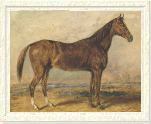
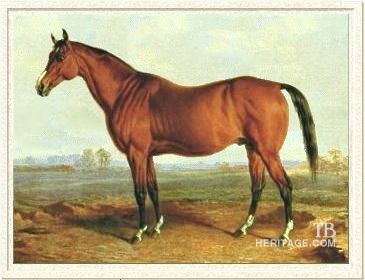
Lexington was a horse of tremendous quality, extremely well made with beautiful action to match. He was medium-sized, 15.3 hands, and his shoulder and hindquarter were extremely powerful. Bruce wrote "He was not a Boston, he was not a Sarpedon, he was not a Timoleon and he was not a Sumpter. In his form the noblest and best qualities of every strain in his blood were combined to form a harmonious union." He was a "light blood bay" with a narrow blaze beginning half way down his face and ending in a snip. He also had four white feet up to the pasterns in front and over the ankles behind. With all this flash, he also showed a lot of white around his eyes, a trait often associated with high-mettled types. In training his temperament was described as perfect, and standing in the middle of intense crowds for his last two engagements, it was remarked how calmly he stood, taking in his surroundings. As a stallion in his blindness, he took on more of the foul temper of his sire, Boston.
His stallion career
The dominant sires of the 1850s were Glencoe and Boston, and both of their stud careers took them within a couple of miles of each other near the little town of Midway in Woodford County, Kentucky. Ten Broeck may have felt this was the the logical place for his champion, as Boston was five years gone and Glencoe, at 24, had only a few years left. He would die in 1857. Glencoe had been standing as the property of William F. Harper since 1848. Ten Broeck arranged for Lexington to join him at Harper's stable on the southwest corner of Old Frankfort Pike and the Midway-Versailles Road, at the blacksmith stand across from the old tavern. Many writers (including this one until recently) have placed Lexington in the charge of John Harper at Nantura Stud, further west on Old Frankfort Pike during this period, which is incorrect. In fact, he stood under the charge of John Harper's cousin, William F. Harper. In 1855, Lexington covered 16 mares at fee of $100.
In the first several weeks of 1856, an ad ran in The Spirit of the Times which stated that Lexington would be making the 1856 season in either Fayette or Woodford County and "he will be limited to 50 mares." Had things changed with Ten Broeck's buisness with Mr. Harper? No farm or fee was mentioned but this little white lie was included: "Lexington's legs and eyes were never better, notwithstanding the reports industriously circulated to the contrary." Lexington was, in fact, going blind and there were skeptics who questioned whether this was going to be something he passed on. After all, Boston had also gone blind. Fortunately time proved this worry unjustified. Later in the spring his fee was announced again at $100 and he covered another 16 mares in 1856 at Harper's stable.
In the summer of 1856, Richard Ten Broeck was in England waiting for his racing invasion plans to unfold. His horses and crew were to arrive in mid-July. That June, he met with Kentuckian Robert A. Alexander, who had recently established Woodburn Stud near John Harper's and William Harper's places in Woodford County. Alexander was in England looking for stallion prospects with his farm superintendent Nelson Dudley. He'd turned down buying Newminster who was standing at Tickhill Castle Stud and already two years in service, but that horse looked like too much of a risk since he was wearing a muzzle. Newminster went on to a brilliant stallion career including twice as Champion Sire in England, so Alexander's loss was England's gain. Ten Broeck convinced Alexander that the best stallion in the world was Lexington, and he could be bought. Alexander was well aware of the horse, who stood just a couple miles down the road from Woodburn. Dudley was all in and recommended Alexander make the purchase, even at the exhorbitant $15,000 price tag. The deal was $7,500 cash and $7,500 with the odd stipulation of "if Lexington was living upon Alexander's arrival in America," and the initial $7,500 forfeit if Lexington were to die before then. Ten Broeck would keep three breeding rights. The agreement was done while Alexander was still in abroad.
What Ten Broeck forgot to reveal was that he'd already made a deal with his former partner, Col. Abe Buford, to purchase Lexington, apparently for something less than $15,000. As it turns out, Lexington had already been led the mile or so down the Midway-Versailles Road from Harper's barn to take up a stall at Buford's Bosque Bonita Farm. One can only imagine the volatile Buford getting his instructions that the deal was off and he was to deliver Lexington to Robert Alexander's farm. Buford already had a bone to pick with Alexander. In 1811 Buford's father Col. William Buford had purchased a tract of land from Alexander's father which sat across Old Frankfort Pike from the main house at Woodburn. The senior Buford developed it into a thriving and influential race horse breeding operation which he called Tree Hill. He stood several stallions important in Kentucky's early breeding history, including Sumpter, Haxall's Moses and Medoc, and he also used many of the stallions standing at his neighbor's property, Col. Ned Blackburn's Equiria, where Boston had stood. Col. Buford died in 1848 and the younger Alexander had to sue his estate for back interest owed on the mortgage which caused bad blood between the families. Seeking to expand his operation, Alexander bought the tract back, allowing the Widow Buford to live at the mansion her husband had only recently completed, until her death in 1866. Unfortunately her sons, Thomas, Henry and Abe Buford, held a grudge. Having to lose Lexington to Alexander would have been demoralizing for Abe Buford.
Lexington's move to Woodburn turned his stud career around. At the same fee of $100, Alexander got 59 mares to him in 1857 and 83 in 1858, thanks in large part to his own sizeable band of high class broodmares, featuring many daughters of Glencoe. This cross produced many of his best runners. When Lexington's first crops came out running, his reputation was made. As the mare books increased, so did the number of stakes winners and champions. He reigned as the Leading Sire in America from 1861 through 1874, and then again in 1876 and 1878, a total of 16 sire championships.
In 1858, Richard Ten Broeck had fallen arrears on his board bill for the mares he kept under Alexander's care at Woodburn. To alleviate the cost, he surrendered his breeding rights in Lexington. The arrangement may have also included Lexington's dam Alice Carneal, which Ten Broeck had been leasing from Dr. Warfield. When Warfield died, Alexander bought the mare outright from his estate, and she died at Woodburn in 1859.
In 1858, Alexander invested building in a new race course in Louisville which he named Woodlawn Race Course. The track opened in 1860 and Alexander commissioned Tiffanys of New York to create a "challenge trophy" for the winner of the track's premier event. The enormous silver sculpture, known today as "the Woodlawn Vase," stands 36 inches high and features the figure of Lexington at the top. The trophy was awarded for several years until Alexander had it buried in the garden at Woodburn to protect it from being melted down during the Civil War. It's now the trophy awarded to the winners of the Preakness Stakes, a race named for one of Lexington's best sons.
The American Civil War (1861 - 1865) impeded on Lexington's stud career in several ways. Some of his offspring were used as cavalry mounts and died in various military actions. Woodburn itself, owned by an English national and flying the English flag in hopes of being spared attack, managed to avoid being raided until late 1864, when Alexander's prize colt, ASTEROID (by Lexington) was stolen by Confederate guerillas. The colt was recognized by Alexander's neighbor and friend, Warren Viley (son of Willa Viley), who caught up with the escaping riders and convinced Asteroid's rider to sell him back for $250, claiming the horse was a family pet.
In February of 1865, more guerillas made off with 15 head, including two of Alexander's best trotting sires, Bay Chief and Abdallah, and a younger brother to Asteroid named Norwich. This last raid prompted Alexander to ship his breeding stock by train, including the stallions Lexington and Australian, to safe harbor in Illinois. The description of the blind Lexington being loaded, literally kicking and screaming, onto the train at Spring Station sets the mood of panic very well. The horses stayed in Illinois for the remaining few months of the war, which ended in April of 1865, at which time they returned home to Kentucky.
Lexington's first small crop produced stakes winners DANIEL BOONE (b.c. 1856 out of Magnolia by Glencoe), a good runner and sire; and LINDORA (b.f. 1856 out of Picayune by Medoc). The second crop included the great racemare IDLEWILD (b.f. 1857 out of Florine by Glencoe); the brilliant colt LIGHTNING (gr.c. 1857 out of Blue Bonnet by Hedgeford); Ten Broeck's homebred OPTIMIST (ch.c. 1857 out of a mare by Glencoe) who brought Lexington's reputation to England where he won stakes; and the winner COLTON (b.c. 1857 out of Topaz by Glencoe), sire of the stallion Monday, who sired the great California-bred mare Mollie McCarthy. From this start came a flood of great runners, classic winners, important sire and broodmares.
IDLEWILD (b.f. 1857 out of Florine by Glencoe) was bred by W. S. Buford and raced by Capt. T. G. Moore. From the age of three through nine, she won 15 races all over the country, from Lexington to New Orelans, Philadelphia, New Jersey, New York, Chicago and St. Louis. Her most famous win was early in her career, when victorious in the second running of the Challenge Vase at Woodlawn Race Course in Louisville. This allowed Capt. Moore to take home the famed Woodlawn Vase for a year. Robert Alexander bought her from Moore and as a broodmare at Woodburn she produced the outstanding runner Wildidle (by Australian) who won stakes in New York and California and became an important early sire in California. Idlewild had a full sister, AEROLITE (ch.f. 1862 out of Florine by Glencoe) who was unraced but produced the champion and Belmont Stakes winner Spendthrift (by Australian), sire of Kingston and Hastings. Aerolite also produced Spendthrift's full brother Fellowcraft, the dam's sire of Hamburg.
|
War Dance, out of famous matron Reel
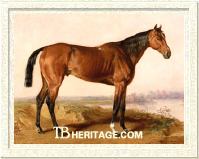
Kentucky
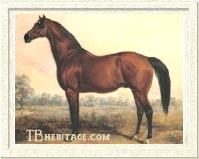
Asteroid
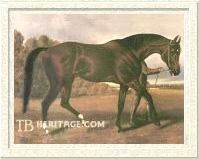
Duke of Magenta
|
|
KENTUCKY (b.c. 1861 out of Magnolia by Glencoe) was a full brother to Daniel Boone, and was bred by John M. Clay. He had 21 wins from 23 starts from two to six. He won the Travers Stakes and two runnings of the Saratoga Cup. As a stallion for August Belmont, he sired the great filly Woodbine (by Censor or Kentucky), Bertram, Count d'Orsay, Dublin and others.
NORFOLK (b.c. 1861 out of Novice by Glencoe) was bred and raced by Robert Alexander at Woodburn. He was the Champion at three in the East, winning the Jersey Derby and Alexander sold him to Theodore Winters for $15,001 to beat the price Alexander paid for his sire. Winters sent Norfolk to California where he won a famous match race with Lodi and became a top sire nationally. His best included champions Emperor of Norfolk and El Rio Rey, and the good California sire Flood. His influence continued through Emperor of Norfolk's son, the sprinter Rey del Carreras, who was renamed Americus when sent to England. Americus sired the speedy Americus Girl, from which descends most of the important members of Family 9-c including Mumtaz Mahal, Mahmoud, Nasrullah, Royal Charger, Fair Trial, Tudor Minstrel, Shergar, Zarkava and others. Emperor of Norfolk also sired Cruzados, who carried Lexington's male line the farthest into the future, ending with El Tesoro (c. 1961) who died in 1981.
ASTEROID (b.c. 1861 out of Nebula by Glencoe) was bred on shares by Alexander with J. C. Chinn and W. W. Boyden. Undefeated in 12 starts, he was the champion of his age in the West (today's Midwest). In the fall of his three-year-old year, he was stolen by Confederate guerillas but was recovered miraculously unscathed. Asteroid was one of Alexander's favorites, but when retired to stud at Woodburn, was a disappointing sire although his get included the good runners Creedmore and Ballinkeel.
MAIDEN (b.f. 1862 out of Kitty Clark by Glencoe) was bred and raced by Robert Alexander and sold to Capt. T. G. Moore. The best three-year-old filly of her year, she won the Travers Stakes against colts. She became a great broodmare, producing six stakes winners including the grand gelding Parole.
MERRILL (ch.c. 1863 out of Miriam by Glencoe) was bred and raced by Robert Alexander and won the Travers Stakes and Jersey Derby at three.
BAYONET (b.c. 1865 out of Bay Leaf by Yorkshire) was bred by Robert Alexander and raced for Capt. T. G. Moore. He was one of the best of his age at three and won the Saratoga Cup at four.
GENERAL DUKE (a.k.a. JUDGE CURTIS) (ch.c. 1865 out of Lilla by Yorkshire) was bred by Robert Alexander. He was the best three-year-old of his year and won the Belmont Stakes. General Duke was renamed JUDGE CURTIS and was sent to stud in Canada where he sired Queen's Plate winners Bonnie Bird and Bonnie Duke.
PAT MALLOY (br.c. 1865 out of Gloriana by American Eclipse) was bred by Robert Alexander and considered the best of his age at three. He came back to stand at Woodburn as a stallion and sired Kentucky Derby winner Lord Murphy and Saratoga Cup winner Bob Miles, who sired Kentucky Derby winner Manuel and Kentucky Oaks winner Janeta.
THE BANSHEE (b.f. 1865 out of Balloon by Yorkshire) was bred by John M. Clay. She won the Travers Stakes at three and the Westchester Cup at four.
|
VAUXHALL (b.c. 1865 out of Verona by Yorkshire) was bred by Robert Alexander. One of the best of his crop at three along with stablemate General Duke, he was the best older horse in training at four and won the Metropolitan Handicap. He sired Preakness/Belmont Stakes winner Cloverbrook, also Viator and Maumee (dam of Nellie Bly).
KINGFISHER (b.c. 1867 out of Eltham Lass by Kingston) was bred by Robert Alexander. He won the Belmont Stakes and Travers Stakes at three. As a stallion for August Belmont, he was a good sire, getting Travers winner Banshee, Monmouth Oaks winner Duchess, the top two-year-old Rica and Belmont mares Mehallah, Lady Rosebery and Magnetism.
PREAKNESS (b.c. 1867 out of Bay Leaf by Yorkshire) was bred by A. J. Alexander (brother to Robert Alexander who inherited Woodburn Stud on Robert's death in 1867) and a full brother to Bayonet. He ran for Milton Sanford and was named for Sanford's farm in New Jersey. Preakness won the Dinner Party Stakes at Pimlico and as the winner, loaned his name to Pimlico's new feature race, the Preakness Stakes. A warrior at the highest level in the handicap ranks through the age of eight, he was sent to run in England and retired to stud there, where he sired the good horse Fiddler. As a stallion for the Duke of Hamilton, Preakness became viscious and the Duke shot him dead, which caused an uproar among the public and initiated legislation to improve the plight of animals in Great Britain.
HARRY BASSETT (ch.c. 1868 out of Canary Bird by Albion) was bred by A. J. Alexander. He was one of the very best sons of Lexington and his leading earner with $56,570 during a career over five years, 40 starts and 25 wins. He the best of his crop at two, three and four, winning the Belmont Stakes, Jersey Derby and Travers Stakes among other events. Unfortunately he wasn't a very good stallion.
WANDERER (ch.c. 1868 out of Coral by Vandal) was bred by A. J. Alexander. He was the best handicapper of 1873, winning the Monmouth Cup and Westchester Cup. He was a useful sire.
TOM BOWLING (b.c. 1870 out of Lucy Fowler by Albion) was bred by H. Price McGrath. He was a great runner and, due to his erratic behavior, was referred to as "The Wild Horse". Champion at two and three, he won 14 of 17 starts including the Jersey Derby, Travers Stakes and Monmouth Cup. He was a moderate sire, his best being General Monroe who won the Saratoga Cup twice.
ACROBAT (ch.c. 1871 out of Sally Lewis by Glencoe) was bred by A. J. Alexander. A stakes winner at two and considered the best of his crop at three in a weak year.
CHESAPEAKE (b.c. 1872 out of Roxana by Chesterfield) was bred by H. Price McGrath. He was the best two-year-old of his year and a good three- and four-year-old. He ran unplaced behind stablemate Aristides in the inaugural Kentucky Derby in 1875.
TOM OCHILTREE (b.c. 1872 out of Katona by Voucher) was bred by A. J. Alexander. He won the Preakness Stakes at three and was among the best handicappers at four and five with wins in the Baltimore Cup (twice), Saratoga Cup, Monmouth Cup and Westchester Cup. He sired a few good ones including Major Domo and Cynosure. He also sired the mare Vacation, who produced Bowling Brook, who won the Belmont Stakes and the Metropolitan Handicap (twice).
SHIRLEY (b.g. 1873 out of Miss Carter by Sovereign) was bred by A. J. Alexander and won the 1876 Preakness Stakes.
SULTANA (b.f. 1873 out of Mildred by Glencoe) was bred by A. J. Alexander and was a full sister to the high class horse Monarchist. She won the 1876 Travers Stakes against colts and was considered the best of her sex that season. She became a useful broodmare for August Belmont.
DUKE OF MAGENTA (b.c. 1875 out of Magenta by Yorkshire) was bred by A. J. Alexander and was Lexington's second leading earner with 15 wins from 19 starts, earning $46,512.50. He was the best two-year-old in the East; at three he was again the champion, winning the Preakness, Withers, Belmont and Travers stakes. He was not a particularly successful sire, but got the Belmont Stakes winner Eric for owner Pierre Lorillard. When he died in September of 1899, he was considered the "last of the Lexingtons."
JACK MALONE (ch.c. 1858 out of Gloriana by American Eclipse) was bred by Joseph C. Guild of Gallatin, Tennessee. He won a sweepstakes (mile heats) at Gallatin, Tennessee as a three-year-old in 1861, then was hidden in Guild's basement during the Civil War. Afterwards he stood at Belle Meade Stud where he was a good sire, getting Muggins and Nellie Ransom among his best. He was an older full brother to Woodburn's own stallion Pat Malloy.
GILROY (b.c. 1862 out of Magnolia by Glencoe) was bred by John M. Clay and was a year-younger brother to Kentucky. He was a stakes winner for James Grinstead, who stood him at stud in Kentucky, where he sired Grinstead (named obviously for his breeder) who became the best two-year-old of his year. As a sire for E. J. "Lucky" Baldwin at the Santa Anita Stud in California, Grinstead sired Silver Cloud and Sinaloa II.
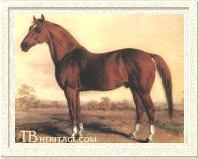
WAR DANCE (ch.c. 1859 out of Reel by Glencoe) was bred by T. J. Wells of Louisiana, and was a half-brother to LeComte. His racing career was short circuited by an injury in his only start and he was sold to A. Keene Richards of Kentucky where he became an important stallion. He sired the great racemare Modesty as well as Bradamante, Bullion, Blue Grass Belle, Monmouth, Monopoly, Sachem, Sly Dance and many others. War Dance was also a great broodmare sire of runners like The Bard, Rainbow, Tea Tray, Riley, Jewel Ban, Long Dance, Eole, Faustus and his sister Mannie Gray (dam of Domino).
Lexington sired top four mile horses like himself but the times were changing and single heat races became the style, then shorter "dash" races. His progeny handled the changes to shorter distances as well. They tended to be larger horses than their sire with a lot of muscle. Lexington sired mostly bays but a fair number of bright chestnuts and the odd grey like Lightning. Nearly all of them had some white about them, either replicating their sire's blaze or adding higher white on the legs. They ran with great speed and courage. They tended to be sound, and very, very few of them went blind, unlike their sire and grandsire.
The raids during the Civil War had pressed hard on Robert Alexander, who was already in ill health, and by April of 1865, the local threat forced him to evacuate his most valuable stock to a farm in Illinois and a racetrack in Ohio. He considered selling out entirely, ordering a catalog made up for the sale which included Lexington and his other stallions including Australian. Fortunately, the war ended that same month and the horses returned to Woodburn by the fall. Plans for the sale were scrapped. Up to this point Alexander had raced an extensive stable, largely with homebreds, but from here on, he decided to breed exclusively for the yearling market and closed the racing side. He didn't live long enough to see the results, dying in December of 1867 at the age of 48.
Alexander willed the farm and livestock to his brother, Alexander John Alexander, who continued the operation with the help of the already assembled expert staff. One of these was Henry Overton, who had been bought as a slave by Robert Alexander, and stayed on after Emancipation to become the stallion groom, his charges including Lexington. Overton's memory of the great stallion was that he was "good tempered but a man had to ride him because no boy was strong enought to control him; every one had to suffer the indignity of being unsaddled..." He also noted that Lexington had "tremendous lung power - when at exercise his neigh could be heard five miles away."
In 1872, a newspaper reported that Lexington "had improved physically" and was on a limited schedule of pasture time, a few hours in the morning and a few more in the afternoon. "It has been six years since Lexington enjoyed this kind of freedom." His illness wasn't described but it was obviously quite debilitating. The rally was short-lived, though. The great horse developed "a nasal catarrh," a chronic discharge from his nostrils suggesting some sort of infection. A photo of Lexington dated 1874 shows an otherwise healthy-looking horse, especially considering his age of 24 years, with a thickening at his throatlatch, probably the result of this infection. It was said that the disease didn't bother him much until the last three months of his life, when he began to decline rapidly. On his last day, his breathing became labored until, "game to the last," Lexington died around midnight on July 1, 1875 at the age of 25.
Lexington was buried outside his stall at Woodburn and his grave was topped with a stone marker, the first monument to a racehorse in Kentucky. This marker had disappeared by the time the famous horse Ten Broeck died at neighboring Nantura Stud in 1887, because his marker has been described as the first of it's kind in the state. The November after Lexington's death, his skeleton was exhumed for study. This may be when the stone was lost. His skull was examined and the cause of death was apparent. A large amount of food matter had lodged inside his skull, forced through a gap in his jaw made by a lost tooth. The material caused an abcess which gradually ate away at the bone on that side of his face for years before his death. It was probably painful, but the great horse didn't show it until the end. Lexington's bones were articulated for public display at the Smithsonian Institute in Washington D.C. His skeleton was moved back to Kentucky in 2010 where it has pride of place at the Museum of the Horse at the Kentucky Horse Park.
Unfortunately, while many of Lexington's sons were successful at stud, none could approach their sire's status as a great stallion. LEVER, VAUXHALL, PAT MALLOY, DUKE OF MAGENTA, UNCAS, WAR DANCE, KENTUCKY and KINGFISHER all sired champions or classic winners. GILROY, JACK MALONE and COLTON were useful, and the most influential of all was NORFOLK, who stood in California and sired the brothers El Rio Rey and Emperor of Norfolk. Many of Lexington's sons were overshadowed by the influx of more fashionable imported stallions, who fortunately worked very well with Lexington mares.
Lexington's daughters were prolific producers and crossed exceptionally well with the other bloodlines of the day, particularly the imported sires. They produced the likes of Salvator, Foxhall, Spendthrift, Ten Broeck, Hindoo, Aristides, Luke Blackburn, Los Angeles, Onondaga, Sensation, Olitipa, Parole, Thora, Wanda, Wildidle, Fellowcraft, Springbok, Himyar, Enquirer, Grenada, Zoo-Zoo, Survivor, Monitor, Blue Wing, Vigil, Day Star, Ben Ali, Attila and many others. These names became the stars of the next generation of American runners. Several breeding establishments were built on the back of Lexington broodmares including Woodburn, Milton Sanford's North Elkhorn/Preakness Stud, Dan Swigert's Stockwood and Elmendorf Studs and Pierre Lorillard's Rancocas Stud.
Lexington's long term influence on the American Thoroughbred was enormous. His children and grandchildren dominated racing and breeding for the second half of the Nineteenth Century, and wove into the foundations of the next century on both sides of the Atlantic. So successful were the descendants of Lexington that they prompted a rule change by the English Jockey Club. Although his pedigree was deemed "impure" by the General Stud Book due to a couple of ancestors deep in his background who did not trace back to the General Stud Book, this hadn't prevented some American-breds with Lexington blood from winning big English races. As early as 1882, Woodburn-bred Foxhall won the Ascot Gold Cup, sired by King Alfonso out of Jamaica, a mare by Lexington. Over the years, more and more carried that tainted strain of Lexington, like Derby winners Orby and Durbar II; Oaks winner Cap and Bells; 2,000 Guineas winner Norman; and 1,000 Guineas winners Sibola, Rhodora, and Atmah. This annoyance prompted the Jockey Club to pass the Jersey Act in 1913, a rule which refused full registration to horses carrying Lexington's blood and any other tainted American strains that didn't go back directly to the General Stud Book. It didn't prevent their participation in these races, but instead marked them as "half-breds."
The Jersey Act was a little late to supper, though. By 1913, Lexington had already seeped into the British gene pool. Two lines are most notable. His great-grandson Americus (nee Rey Del Carreres) arrived in England in 1896. The descendants of Americus' fully registered daughter Americus Girl, through which the great families of Mumtaz Mahal and Lady Juror, produced floods of important runners and breeding stock. Lexington's great-great granddaughter Sibola also sneaked across to England in 1897, and won the 1,000 Guineas in 1899. Sibola's progeny were fully registered and her great-grandson Nearco (foaled in 1935) blazed another trail. The Jockey Club recinded the Jersey Act in 1949, reasoning that the impure blood in Lexington's pedigree was finally far enough back to do no more harm. The decision may have been influenced by the fact that Nearco had been the Leading Sire in 1947 and 1948, carrying the golden blood of Lexington on to the next generation.
--Anne Peters
|
|
|
|